Reality Stares Back: Physicists May Be Asking the Wrong Questions.
Imagine standing at the edge of the cosmos, peering into the heart of reality itself, only to realize the universe is staring right back at you.
When we probe the cosmos with classic queries—How is our world built? What is it truly made of?—we assume we are neutral observers unravelling a finished tapestry. But step into the hall of mirrors that is quantum physics, and that comfortable assumption shatters. Down in the subatomic realm, reality behaves less like a physical monument and more like a shapeshifting illusion.
The moment we attempt to pin down a particle, it seems to anticipate our intentions. Ask if it is a wave, and it ripples; ask if it is a discrete point, and it snaps into focus. It is as though the microscopic world isn't simply revealing its secrets, but actively reflecting our own expectations back at us like a cosmic echo chamber. Perhaps the deepest vexation isn't that the micro-world is stranger than we suppose, or even weirder than we can imagine. Perhaps the problem is far more fundamental: we may be asking entirely the wrong questions.
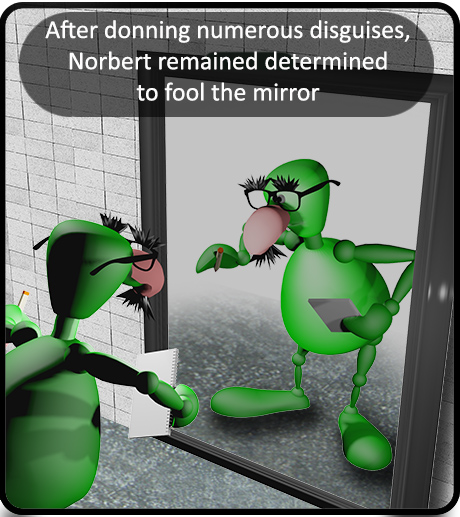
Think of it like wearing glasses.
If the guy above looking at the cosmos puts on red-tinted glasses, everything he sees looks red. The cosmos isn't turning red on purpose; it’s just responding to the glasses he picked. The big question becomes: "What if the answers he gets are just reflections of the glasses he's wearing?"
That's the core idea of analytical thinking:
Words set the rules: The questions we ask determine the answers we get.
Bad questions cause confusion: Worrying about what a particle does when no one is looking is like asking, "What does the color blue taste like?" It's just a mismatch of words.
Focus on what you can measure: If you can't test it or see it, it isn't part of the real equation.

Free Will: Not Missing, Just Out of Focus.
WHAT ABOUT FREE WILL?
Applying the camera filter idea to free will completely changes how we look at the debate. Instead of asking, "Do we really have free will?", we should ask: "Which filter are we using when we talk about free will?" Here is how it works:
The Science Filter:
If you look at a human through physics and biology, you only see brain signals, chemical reactions, and cause-and-effect. Through this filter, "free will" doesn't show up—just like color doesn't show up on a black-and-white camera.
The Everyday Filter:
If you look at a human through life, law, or friendship, you are looking at choices and personal responsibility. Through this filter, "free will" just means you made a decision on your own without someone forcing you.
The Bad Question:
Asking if free will "actually exists" in the physical world is like asking "What does the color blue taste like?" You are mixing two different topics that don't belong together. You can't find a human idea like "choice" under a microscope. The Bottom Line: Free will isn't a magical force. Whether it "exists" depends entirely on the tools and language you use. In science class, the word doesn't fit the experiment; in everyday life, it's a useful way to describe making choices.
-

-
‘You must be the change you wish to see in the world. If you want to stop terrible things happening in the world first stop them in yourself. If you want peace and joy then find them in yourself’.
-

Be the Change? You Already Are: Don't Fight the Mirror, Fix the Reflection's Owner.
When consciousness is understood as the primary ontological foundation—the ground of all being—Gandhi’s famous insight shifts from an ethical advice column to an exact description of how reality functions.
If mind and matter are two sides of the same coin, then reality is not an objective, external mechanism that happens to us; it is a shared, continuous projection arising from consciousness itself.
Here is how these ideas connect across three distinct levels:
1. The Individual Level: The Body as Personal Sculpture
If consciousness precedes matter, physical reality is downstream from mental state.
- Gandhi’s Principle: "If you want peace and joy, find them in yourself."
- The Ontological Primacy: You are not a passive observer receiving emotional states from your environment. Your mental state actively molds your immediate material experience. Your physical body, health, habits, and daily actions act as a "personal sculpture"—the direct physical expression of your internal mind.
- The Implication: Changing your internal state automatically alters your immediate physical expression.
2. The Collective Level: Culture as Shared Sculpture
When multiple conscious entities interact, their individual projections overlap to construct shared social reality.
- Gandhi’s Principle: "If you want to stop terrible things happening in the world, first stop them in yourself."
- The Ontological Primacy: Culture is not an abstract entity existing independently of people; it is a collective sculpture held in place by the combined conscious states of every individual within it. Systemic violence, hostility, or greed are simply the macro-reflections of unaddressed internal turmoil within individual minds.
- The Implication: You cannot "fix" a cultural dynamic purely through external force while maintaining an internal state of hostility, because doing so continues to feed the very consciousness that built the culture in the first place.
3. The Cosmic Level: The World as Joint Creation
At the largest scale, the physical universe is the ongoing evolution of mind and matter unfolding together.
- Gandhi’s Principle: "You must be the change you wish to see in the world."
- The Ontological Primacy: Because you and the universe are undivided, you are never not affecting the world. The boundary between "inside" and "outside" dissolves. Imagination and intention are not idle daydreaming; they are the preliminary drafts of physical manifestation.
- The Implication: You do not need to gain power to affect the world—you are already affecting it by existing as a node of consciousness within the whole. Gandhi’s call to action is an invitation to take conscious control of the influence you are already exerting.
The Synthesis
By placing consciousness as the ontological prime, Gandhi’s message transforms:
Internal State (Consciousness) → External Reality (Matter/Culture)
You are not a tiny creature trapped inside a vast, alien universe. You are an active participant whose internal state contributes directly to the ongoing creation of reality. To change the world, you do not fight the reflection in the mirror; you change the entity standing in front of it.
